
Learning Difficulties
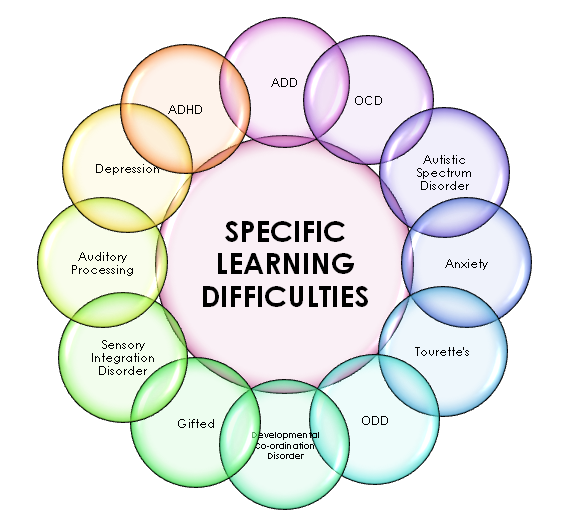
Many neurodevelopmental conditions can often exist together, but each can be treated in different ways. The picture below illustrates how the conditions overlap. Please use the drop down menu to view other conditions.
What Are Specific Learning Difficulties ?
Specific learning difficulties (SLD) is an umbrella term used to cover a variety of difficulties which can range in their severity. The main specific learning difficulties include:
- Dyslexia – difficulty with words
- Dysgraphia – writing difficulties
- Dyspraxia – motor difficulties
- Dyscalculia – difficulty with mathematical calculations
Learning difficulties typically affect an individual’s motor skills, information processing and memory.
What Is Dyslexia ?
Dyslexia is the most commonly known learning difficulty. It affects both written and spoken language. It occurs due to difficulty with processing information, visual and auditory perceptual skills, short term memory as well as concentration and organisation.
What Is Dysgraphia ?
Dysgraphia refers to difficulty with written work which can result in written work being messy, illegible and poor spelling. This is usually due to a lack of coordination and fine motor skills. This difficulty does not reflect an individual’s intelligence.
How Common Are Specific Learning Difficulties ?
It is estimated that between four and five percent of the population have an SLD and research has shown that boys and girls are just as likely to have an SLD.
What Causes Specific Learning Difficulties ?
An SLD is caused due to difficulties during brain development, either before birth, during birth or in early childhood. Risk factors include:
- Mother becoming ill during pregnancy
- A lack of oxygen to the brain during birth
- Illness, such as meningitis
- Injury during early childhood.
There are some conditions that are associated with having a learning difficulty, including cerebral palsy, Down’s syndrome, autism and epilepsy.
How Are Specific Learning Difficulties Managed ?
There is no cure for SLDs. However, the severity of the individual’s difficulty affects how severely it affects their learning process. Difficulties can be alleviated by skilled specialist teaching and committed learning.