
Tourette's
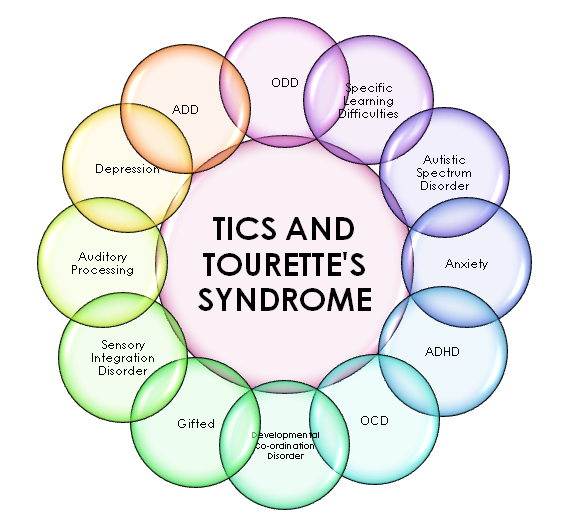
Many neurodevelopmental conditions can often exist together, but each can be treated in different ways. The picture below illustrates how the conditions overlap. Please use the drop down menu to view other conditions.
What Is A Tic?
A motor tic is when a part of the body makes a quick, sudden, uncontrollable movement. Tics can affect any part of the body such as the face, shoulders, hands or legs and may happen many times.
A vocal tic is an involuntary sound made over and over again, for example throat clearing or a humming noise. Most tics are mild and do not cause much upset to everyday life. However if they are frequent and severe they can affect many areas of a child’s life. Tics do not occur when asleep. Sometimes a child can ‘hold’ the tics in for a period of time but then have an outburst of tics later. This is not done on purpose.
Transient Tic Disorder
This is when a child has tics that happen almost every day for more than four weeks. It is very common and affects almost one in four children at some point.
Chronic Tic disorder
This is when tics have been happening for over a year. It is much rarer and affects between 1-2% of children at some stage. Rarely, a child will go on to develop Tourette’s Syndrome. This is the rarest type of tic disorder and occurs when there are both motor and vocal tics which gradually become more and more complicated and cause significant problems in the child’s life. Most children who have a tic disorder do not have Tourette’s syndrome.
What Causes A Tic Disorder?
Tic disorders generally come on around the age of 7-9 years and tend to affect boys more than girls.
How Can You Manage Tics ?
What Is Tourette's Syndrome ?
What Are The Symptoms of Tourette's Syndrome ?
Examples of motor tics
Various facial gestures Grooming the hair
Squatting Retracing footsteps
Eye blinking Eye rolling
Neck jerking Head nodding
Examples of vocal tics
Clearing the throat Coughing
Squeaking or squealing Grunting
Stuttering Unusual sounds
Sniffing Humming
What Are The Causes Of Tourette's Syndrome ?
How Common Is Tourette's Syndrome ?
What Is The Treatment For Tourette's Syndrome ?
Medication is also available to help alleviate tics, typically neuroleptics, dopamine receptor blocking drugs. Unfortunately, the effect of medication varies between individuals, with some having well-controlled tics when on medication, and others with very little difference.